The Fastest Way to Become a Senior Engineer Is to Make Yourself Replaceable
The best senior engineers don't just solve difficult problems—they create more engineers capable of solving them. Reflecting on lessons learned throughout my career, I explore why mentorship, judgment, and investing in others remain the fastest path to growth, even as AI transforms the way we build software.
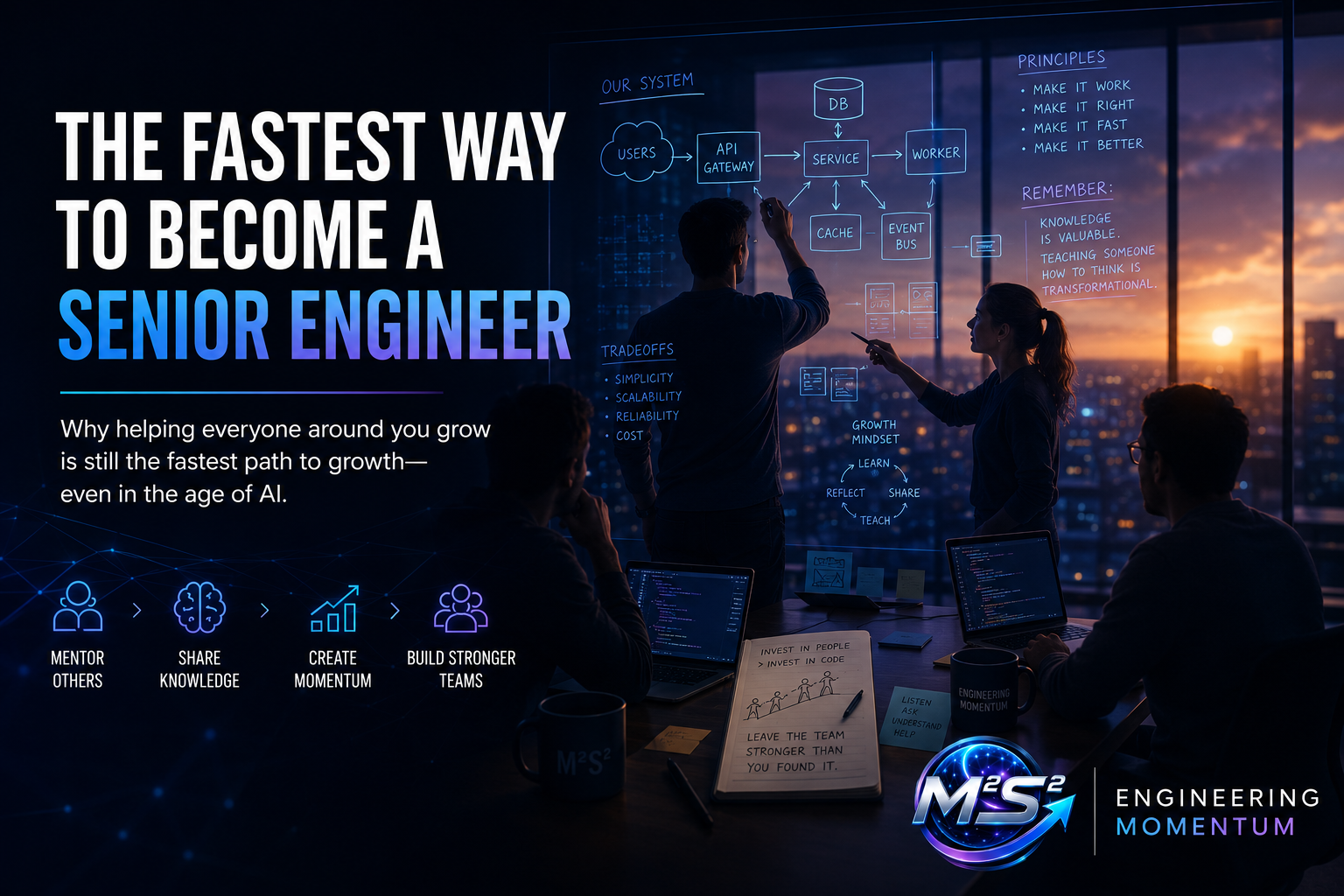
Why helping everyone around you grow is still the fastest path to career growth—even in the age of AI.
Introduction
One of the best pieces of career advice I ever received came from my first engineering manager. Early in my career, I was eager to prove myself by taking on difficult problems, becoming the person people relied on, and making sure I was contributing as much as I possibly could. During one of our conversations, he offered a piece of advice that didn't make much sense to me at the time.
"If you want to get promoted, make it so you're no longer needed in your current role."
I remember thinking that sounded completely backwards. Why would I want to make myself unnecessary? Wouldn't that simply make me easier to replace?
More than fifteen years later, after working as an engineer, technical lead, engineering manager, and now stepping into a director role, I finally understand what he meant. He wasn't telling me to become less valuable. He was teaching me that organizations don't promote people because they're indispensable in their current position. They promote people because they've demonstrated they can create success that extends beyond themselves.
The Hero Trap
Early in our careers it's easy to confuse being needed with being valuable. We become the person who understands the deployment pipeline, the only engineer comfortable debugging a legacy service, or the one everyone calls when production goes sideways. It feels rewarding because people depend on us, but dependence comes at a cost. If the team can't move without you, you've unintentionally limited both the organization's growth and your own.
Every promotion I've experienced has expanded the question being asked. Junior engineers are expected to solve problems. Senior engineers are expected to help others solve problems. Technical leaders are expected to create environments where entire teams solve problems more effectively. The scope changes, and with it, the definition of value.
The Best Senior Engineers Create More Senior Engineers
When I think back over my career, I don't remember the best engineers because they wrote brilliant code or always had the right answer. I remember them because they invested in me.
There were countless times when I'd sit beside a senior engineer as they walked me through a complicated system, reviewed one of my pull requests, or explained why an architectural decision had been made years before. Sometimes we'd spend an hour tracing a production issue. Other times we'd sketch diagrams on a whiteboard or simply talk through the tradeoffs between two approaches. At the time, I viewed those conversations as opportunities to solve whatever problem happened to be in front of us.
Looking back, I realize they were doing something much more valuable.
They weren't simply helping me solve that day's problem—they were teaching me how they thought. They were sharing years of experience earned through difficult projects, production outages, failed ideas, and hard-earned successes. Every code review, every architecture discussion, and every thoughtful question was quietly reshaping how I approached engineering. Those lessons accumulated over time until I found myself asking better questions, recognizing patterns more quickly, and making decisions with greater confidence.
One realization has stayed with me ever since:
Knowledge is valuable. Teaching someone how to think is transformational.
That, more than anything else, is what great senior engineers do. They don't just leave behind well-designed systems; they leave behind better engineers.
A code review isn't simply about catching bugs. It's an opportunity to teach judgment.
A design review isn't just about approving an architecture. It's an opportunity to explain tradeoffs.
Helping someone debug a production issue isn't only about restoring service. It's an opportunity to help them recognize patterns they'll carry with them for the rest of their career.
The best senior engineers create more senior engineers. When that happens consistently, expertise stops living inside individuals and becomes part of the team's culture. That's how engineering organizations become stronger over time.
What Changes in the Age of AI?
That lesson feels even more relevant today than it did when I first heard it.
AI has dramatically changed the mechanics of software development. It can generate code, explain unfamiliar frameworks, summarize pull requests, write documentation, and accelerate many of the tasks that used to consume a large portion of an engineer's day. Those are remarkable capabilities, and they've already changed how I work.
What AI hasn't changed is how engineers develop judgment.
An AI assistant can explain what a piece of code does. It can't fully explain why an experienced engineer rejected three other approaches before arriving at the one you're looking at. It can recommend a design pattern, but it doesn't have years of context from your organization, your customers, or the production incidents that shaped your team's thinking. Those lessons are still passed from one engineer to another through conversation, mentorship, and shared experience.
In many ways, I think AI makes those human interactions even more valuable. If everyone has access to increasingly capable tools, then technical knowledge becomes easier to acquire. The differentiator becomes judgment, communication, and the ability to elevate the people around you. Those are skills that aren't downloaded—they're cultivated.
Engineering Momentum
At M²S², we talk a lot about Engineering Momentum, and I don't believe momentum is measured by how many lines of code a team produces or how quickly features are delivered. Real momentum happens when an organization becomes progressively more capable over time. It happens when knowledge is shared instead of hoarded, when experienced engineers invest in those around them, and when every promotion leaves the team stronger than it was before.
Looking back, I realize my manager wasn't telling me to work myself out of a job. He was challenging me to build something that could succeed without depending on me. Every engineer who took the time to mentor me did exactly that. They invested in my growth so that one day I could solve problems they no longer had to solve, freeing them to tackle even bigger challenges.
When I think about the engineers who had the greatest impact on my career, I don't remember the features they built or the incidents they resolved. I remember the conversations. I remember the questions they asked. I remember the patience they showed when they took time out of their day to help me become a better engineer.
If my career leaves behind anything worthwhile, I hope it isn't just software. I hope it's that someone approaches a difficult problem differently because of a conversation we had years earlier.
To me, that's what engineering momentum really is.