Good Architecture Creates Engineering Momentum
Most software projects do not struggle because the first version was hard to build. They struggle because important decisions were not made clearly enough, early enough, or visibly enough.
At first, that can feel harmless. The team is moving quickly. The product is taking shape. The first version works. Everyone understands just enough to keep going.
Over time, the missing decisions start to show up. A service boundary that was never clearly defined begins to blur. A database choice that worked for the first release becomes harder to evolve. Ownership gets fuzzy. Scaling assumptions go untested. Failure paths are discovered during incidents instead of design conversations.
None of this means the team did anything wrong. Most teams are making the best decisions they can with the information, deadlines, and constraints they have at the time. Early in a project, speed matters. Learning matters. Getting something in front of users matters.
The problem is not moving quickly; it is moving quickly without ever stepping back to understand which decisions are becoming foundational.
That is where architecture matters.
Not as a silver bullet. Not as a guarantee that a system will scale perfectly or that a team will never make mistakes. Good architecture is not about predicting every future requirement or creating process for the sake of process.
Good architecture is about making important decisions visible early enough that teams can move with more confidence later.
Architecture Is Practical Decision-Making
When people hear the word architecture, they often think of diagrams, design documents, or large upfront planning exercises. Those things can be useful, but architecture is bigger than the artifacts.
At its core, architecture is the set of decisions that shape how a system behaves over time. It defines how components relate to each other, where data lives, how services communicate, how failures are handled, and how the system will be operated once it reaches production.
A good architecture does not need to be complicated. In many cases, the best architecture gives the team the simplest path to a reliable outcome.
The goal is not to make the system look sophisticated. The goal is to make it understandable, changeable, and operable. A well-designed system makes tradeoffs easier to discuss and future changes easier to reason about.
That kind of clarity is one of the most underrated parts of engineering.
Speed Still Matters
Architecture sometimes gets framed as the opposite of speed. I don’t think of architecture this way.
Fast-moving teams need architecture too. They may not need a heavy design process, but they still need shared understanding. They still need to know what decisions are temporary, what decisions are foundational, and what complexity they are accepting on purpose.
Skipping that conversation can feel faster in the short term, but the cost often shows up later as hidden dependencies, unclear ownership, unreliable deployments, scaling issues, or systems that only a few people understand.
This is usually not one dramatic failure. It is gradual friction. Features take longer to explain. Changes carry more risk. Releases become more stressful. The system still works, but it becomes harder to move.
Architecture helps by bringing some of that friction into the open before it becomes expensive.
Architecture Should Create Confidence
Good architecture does not remove uncertainty. Requirements change. Usage patterns change. Business priorities change. Teams learn by building.
The purpose of architecture is to give the team a better way to operate inside that uncertainty.
A strong system design gives engineers a shared mental model. It helps them understand where new functionality belongs, what parts of the system are sensitive, and what tradeoffs are already in play. It also helps leaders connect technical decisions to business outcomes.
When architecture is clear, conversations become more practical. Cost, timeline, reliability, scalability, security, and maintainability can be discussed honestly instead of being treated as vague technical concerns.
That is where architecture becomes useful.
It improves communication. It supports planning. It gives testing, observability, security, and operational readiness a stronger foundation. Most importantly, it gives teams more confidence that they are building in a direction the business can support.
That confidence is momentum.
Review Early, While Change Is Still Cheap
Architecture reviews are often treated as something that happens late, after a system is already designed, partially built, or running in production. By then, the cost of change is higher.
Late reviews can still help, but early reviews create more options.
A useful review does not need to be heavy or ceremonial. It can be as simple as explaining the design clearly, examining the assumptions behind it, and identifying where future pain is likely to appear.
This is where experience matters.
An experienced review is not just looking for a clean diagram. It is looking for pressure points: unclear ownership, undefined failure behavior, optimistic scaling assumptions, fragile data flows, missing observability, and operational complexity the team may not be ready to own.
That kind of review is not meant to block progress. It is meant to protect it.
AI Can Help Start the Conversation
One way to make architecture review more accessible is to lower the barrier to getting feedback.
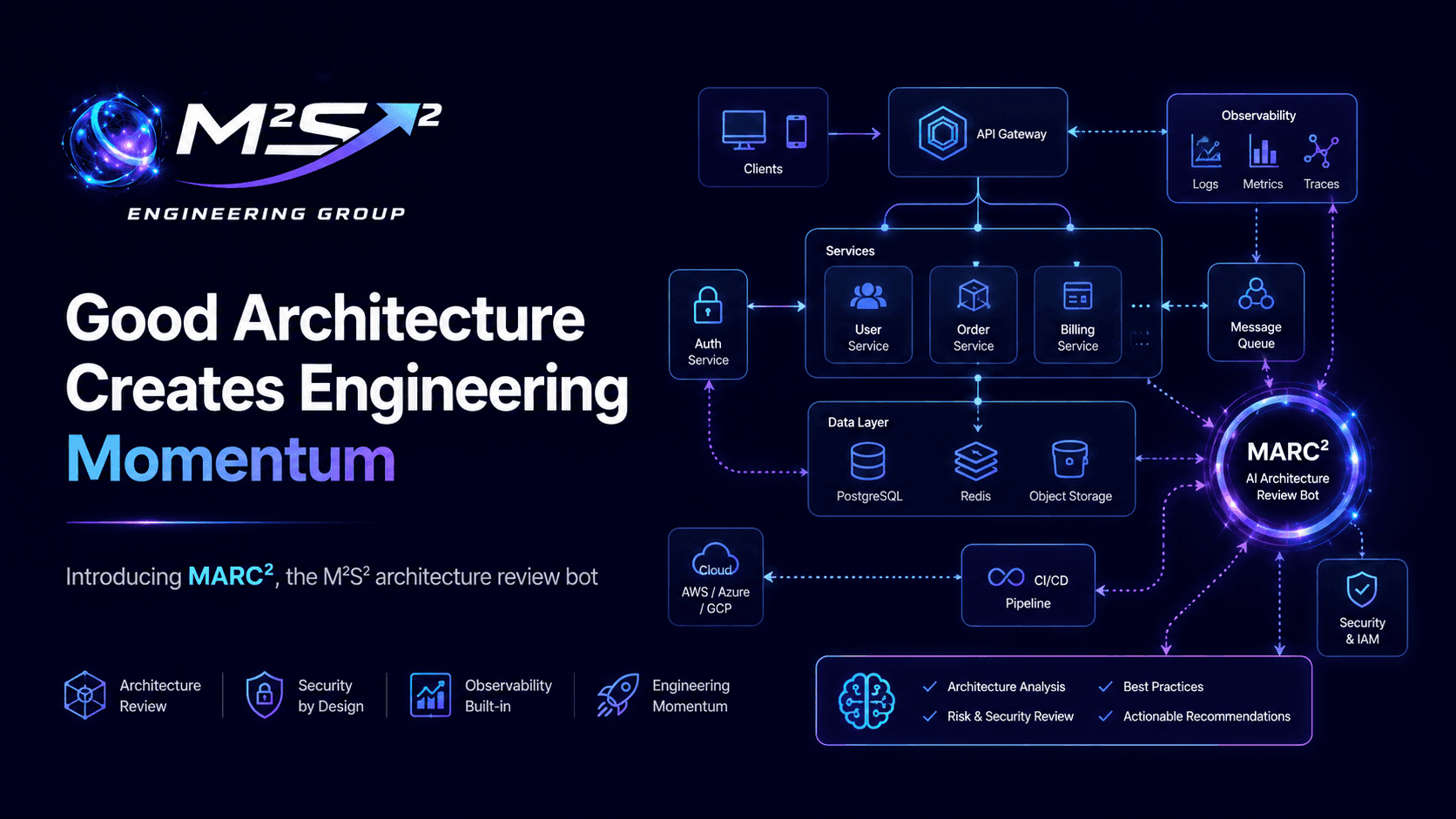
That is why I added MARC², the M²S² architecture review bot, to the website.
The goal is not to replace an experienced architect. MARC² is not meant to understand every business constraint, team dynamic, compliance requirement, or operational reality behind a system. No automated tool can do that completely.
But it can be a useful first step.
MARC² gives teams a lightweight way to take an initial pass at their design, surface areas that deserve more attention, and clarify assumptions that might otherwise stay hidden. That includes concerns around scalability, reliability, security, data flow, service boundaries, observability, and production readiness.
Most importantly, it can help start the right conversation earlier.
That is where I think AI is useful in engineering. Not as a replacement for judgment, but as a way to improve feedback loops. Sometimes the value of a review is not producing the final answer. It is helping the team see the system more clearly.
If MARC² identifies a risk you had not considered, that is useful. If it helps you explain your architecture more clearly, that is progress. If it leads to a better conversation with your team, it has done its job.
MARC² is meant to be a starting point, not the final answer.
Better Design Creates Better Movement
A lot of system design comes down to understanding where complexity belongs.
Every meaningful system has complexity somewhere. The goal is not to eliminate it entirely. The goal is to make sure the complexity is intentional, visible, and owned.
Sometimes the right tool for the job is a simpler architecture than the team first imagined. Other times, additional structure is justified because the operational risk demands it. It may mean choosing proven technology the team already knows how to support, or delaying a microservice boundary until the domain is better understood.
That is why architecture is less about having the right pattern and more about understanding the tradeoffs behind the pattern.
A monolith can be the right choice. Microservices can be the right choice. Serverless can be the right choice. Containers can be the right choice. The value comes from knowing why a choice fits the system, the team, and the business at that point in time.
Good architecture gives teams room to adapt. It does not require every decision to be perfect or every edge case to be solved upfront. It gives the team enough clarity to move without constantly fighting the system.
That is what I mean by engineering momentum.
Architecture Is a Business Concern
Architecture is often treated as something only engineers care about, but it has a direct impact on the business.
It affects how quickly teams can deliver, how safely they can change the system, how reliably the product runs, how easily new engineers can contribute, and how confidently the organization can respond to new opportunities.
A system that is hard to understand becomes expensive to change. A system that is hard to operate becomes risky to scale. A system that only a few people understand becomes fragile.
These are not just technical problems. They are business problems.
That is why architecture should be visible enough for teams and leaders to make informed decisions together. Good system design creates alignment between technical choices and business goals. It gives everyone a clearer understanding of what is being built, what risks exist, and what tradeoffs are being made.
That alignment is one of the strongest signals of a healthy engineering organization.
From First Pass to Forward Momentum
If you are building a new system, preparing for launch, modernizing an existing platform, or trying to understand whether your architecture can support what comes next, a review is a good place to start.
The first step is often describing the system clearly enough that someone else can understand it. Once the components, data flow, dependencies, assumptions, and operational model are visible, the risks become easier to discuss.
MARC² is designed to help with that first pass. It can surface risks, clarify assumptions, and give teams a useful first look at where their architecture may need more attention.
But architecture still requires judgment.
The important decisions usually live in the context around the system: the business goals, the team’s experience, the delivery timeline, the operational expectations, the budget, the existing technical debt, and the tradeoffs the organization is willing to accept.
That is where experienced guidance matters.
If MARC² helps you identify areas worth discussing, M²S² can help you take the next step. Whether you are building a new system, preparing for launch, modernizing an existing platform, or trying to understand why delivery has started to slow down, an architecture review can help turn uncertainty into a clearer path forward.
The goal is not perfect architecture.
The goal is better decisions, earlier feedback, and systems that can keep moving.
That is where momentum begins.
MARC² can help you start the conversation. M²S² can help you turn it into action.