
I Choose Angular Over React for Large Projects. Here's Why.
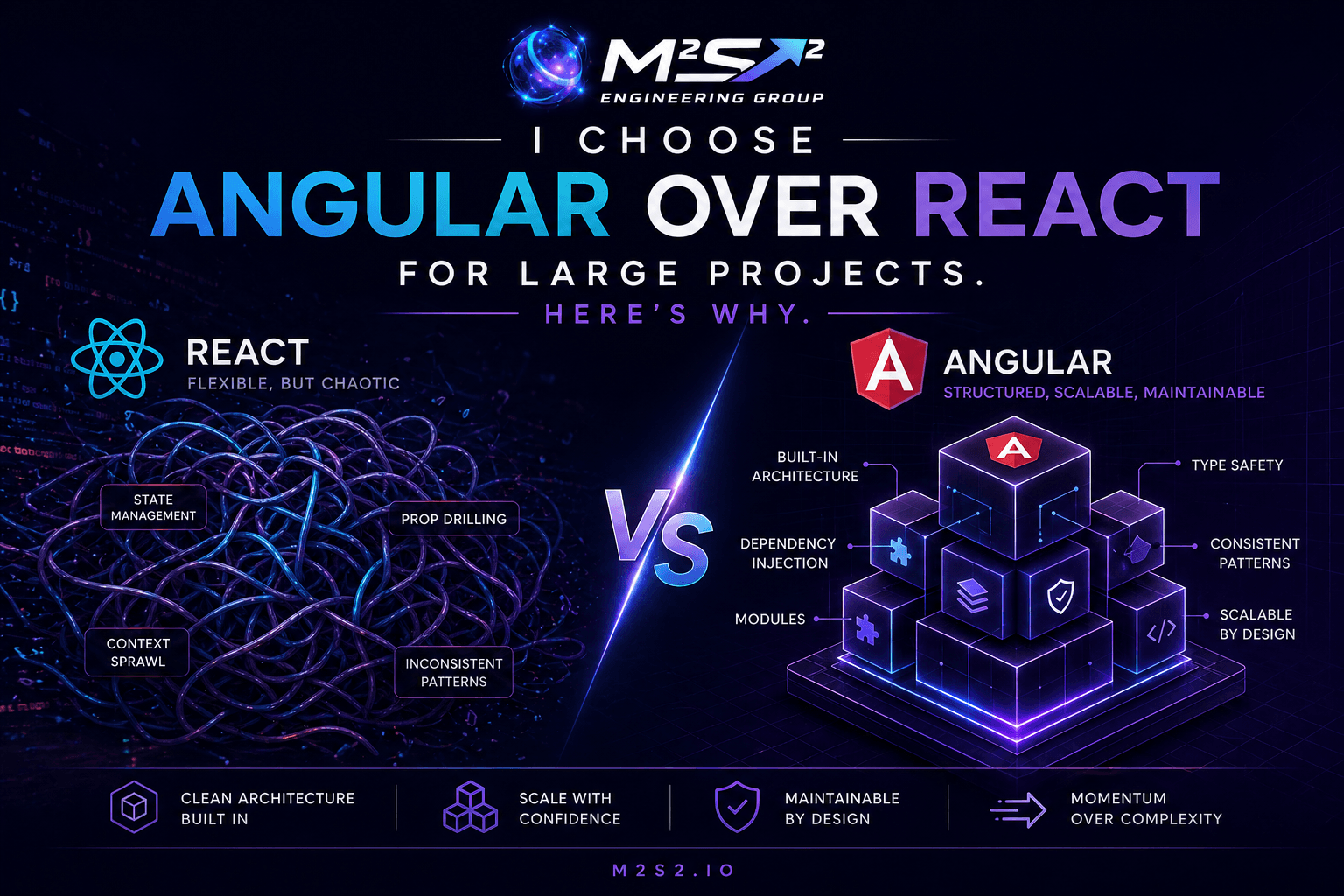
I know what you're thinking. The job boards say React. The bootcamps say React. Every "top frameworks 2025" listicle says React. I'm not here to tell you React is bad — it isn't. But after 15 years across five industries, teams ranging from 3 to 20 engineers, and frontend codebases that had to survive long past their original authors, I keep reaching for Angular when the stakes are high. Here's the honest case for why.
Let me establish some credibility first
I'm not an Angular developer who hasn't touched React. I've shipped React in production — TypeScript, hooks, the whole ecosystem — on real teams with real users. I know the flexibility. I've felt the speed of spinning something up.
I've also led Angular teams building platforms and component libraries that are still in production today, maintained by engineers who had nothing to do with writing them. That last sentence is the whole argument, really.
React's ecosystem is a feature. On large teams, it's also a trap.
React gives you a rendering library and says "figure out the rest." For a senior engineer who has already figured it out, that's liberating. For a 15-person team with mixed experience levels, it's a slow-motion debate club.
Pick your state management: Redux? Zustand? Jotai? Recoil? MobX? Context with useReducer? Each has passionate advocates and legitimate use cases. So your team has a meeting. Then another. Someone posts a benchmark. Someone else posts a counter-benchmark. Two weeks later you've adopted Zustand, three engineers aren't sure why, and two secretly wish you'd picked Redux because that's what they know.
Now do the same exercise for data fetching. React Query or SWR? RTK Query? Plain useEffect with a custom hook? Axios or fetch? And folder structure — features-based or type-based? Where do shared utilities live? What about form handling — React Hook Form, Formik, or something homegrown?
None of these are wrong questions. All of them are genuinely debatable. But on a large team, every unanswered convention is a future argument, a future inconsistency, and a future onboarding headache. The flexibility that makes React feel fast in a solo project accumulates into friction at scale.
Angular answers most of these questions before you write a single line of code. Services for state and data. HttpClient for API calls. Reactive Forms for complex form handling. A CLI that generates consistent, predictable scaffolding. You can disagree with Angular's answers — but everyone on your team is working with the same answers, and that consistency compounds over years.
Onboarding is where this really shows up
I've watched senior engineers drop into large React codebases and spend weeks just mapping the terrain. Not because they weren't capable — they absolutely were — but because every codebase has made different decisions. Different state patterns, different folder conventions, different data-fetching abstractions, all layered on top of each other as the team's opinions evolved over time. There's no map. You have to draw your own.
With Angular, I've handed a junior developer a quick tutorial and some guidance and watched them make meaningful contributions within days. Not because Angular is simpler — it isn't — but because the conventions are already there. A new engineer knows where services live, knows how components are structured, knows how to inject a dependency. The framework is the map.
The guardrails aren't limitations. They're structure. And structure is what lets engineers at every level focus on solving the actual problem instead of navigating codebase archaeology.
Angular isn't your grandfather's framework
If the last time you seriously looked at Angular was the AngularJS era or even Angular 2–8, you're carrying a mental model that doesn't match the current reality. The framework has evolved dramatically.
Standalone components removed the NgModule overhead that used to be one of Angular's most common friction points. Now a component declares its own dependencies directly — you open one file and see everything it needs. No hunting through module declarations to understand the dependency graph. With modern IDE tooling, jumping to any dependency is a keystroke away.
Signals brought a modern, explicit reactivity model that rivals anything in the React ecosystem. Zone.js is becoming optional. The bundle sizes are competitive. The developer experience — template type checking, language service, CLI — has matured to the point where it genuinely gets out of your way.
The Angular of 2026 is not what critics are usually criticizing. The framework has quietly had one of the most impressive evolution arcs in frontend history, and a lot of the React community hasn't noticed because they stopped paying attention a few versions ago.
TypeScript first, not TypeScript adjacent
Angular was designed with TypeScript from the ground up. The compiler catches template type errors at build time — pass the wrong type to a component input, reference a property that doesn't exist in your template, and the build fails. You find out immediately, not in production.
React with TypeScript is genuinely good. But TypeScript is optional in React, and optionality in a large codebase is a liability. You'll inherit files written before TypeScript was added. You'll find any used as an escape hatch. You'll see prop interfaces that diverged from reality months ago. Angular's compiler is less forgiving — and on a large team, less forgiving is a feature.
Dependency injection changes how you architect
This is the one React developers tend to wave away until they've lived with it. Angular's DI system makes service boundaries explicit. You define a service, declare where it lives in the injector hierarchy, inject it where you need it. Testing becomes trivial — swap the real service for a mock and your component tests have no idea the difference.
React's answer is context, custom hooks, and discipline. Context works. Custom hooks are elegant. But discipline is not a framework feature — it degrades over time, especially as teams grow and change. I've seen React codebases where data fetching logic had migrated into components because "just this once," and that pattern had replicated itself across dozens of files. Angular's DI doesn't prevent bad decisions, but it makes the good patterns the path of least resistance.
Where React genuinely wins
Intellectual honesty matters here. React is the right call in real scenarios:
- Ecosystem breadth — more third-party libraries, more community examples, and frankly more AI awareness. React's dominance means LLMs have seen more React code, which matters when AI-assisted development is part of your workflow.
- Hiring — more React engineers available, and that matters when you're scaling fast
- Rapid prototyping — React plus Next.js is hard to beat for getting something live quickly
- React Native — if mobile is in scope, the story is much cleaner
- Small teams with strong opinions — if everyone has been writing React for years with aligned conventions, you may not feel the pain points I'm describing
The framework isn't the bottleneck. The team is.
The right framework is the one your team can stay consistent with at your current size and growth rate.
Small team, short time horizon, everyone senior — React's flexibility is an asset. The overhead of Angular's conventions may slow you down more than the structure helps.
Large team, long time horizon, mixed experience levels — Angular's conventions are load-bearing. The structure isn't overhead, it's the thing that keeps twenty engineers pointing in the same direction eighteen months from now.
I've been on both sides of this. I know which late-night debugging sessions I'd rather not repeat.
At M²S², we help engineering teams make exactly these kinds of decisions — not based on what's trending, but based on what actually works at your scale. If you're weighing your options, let's talk.
Originally published at m2s2.io